In short
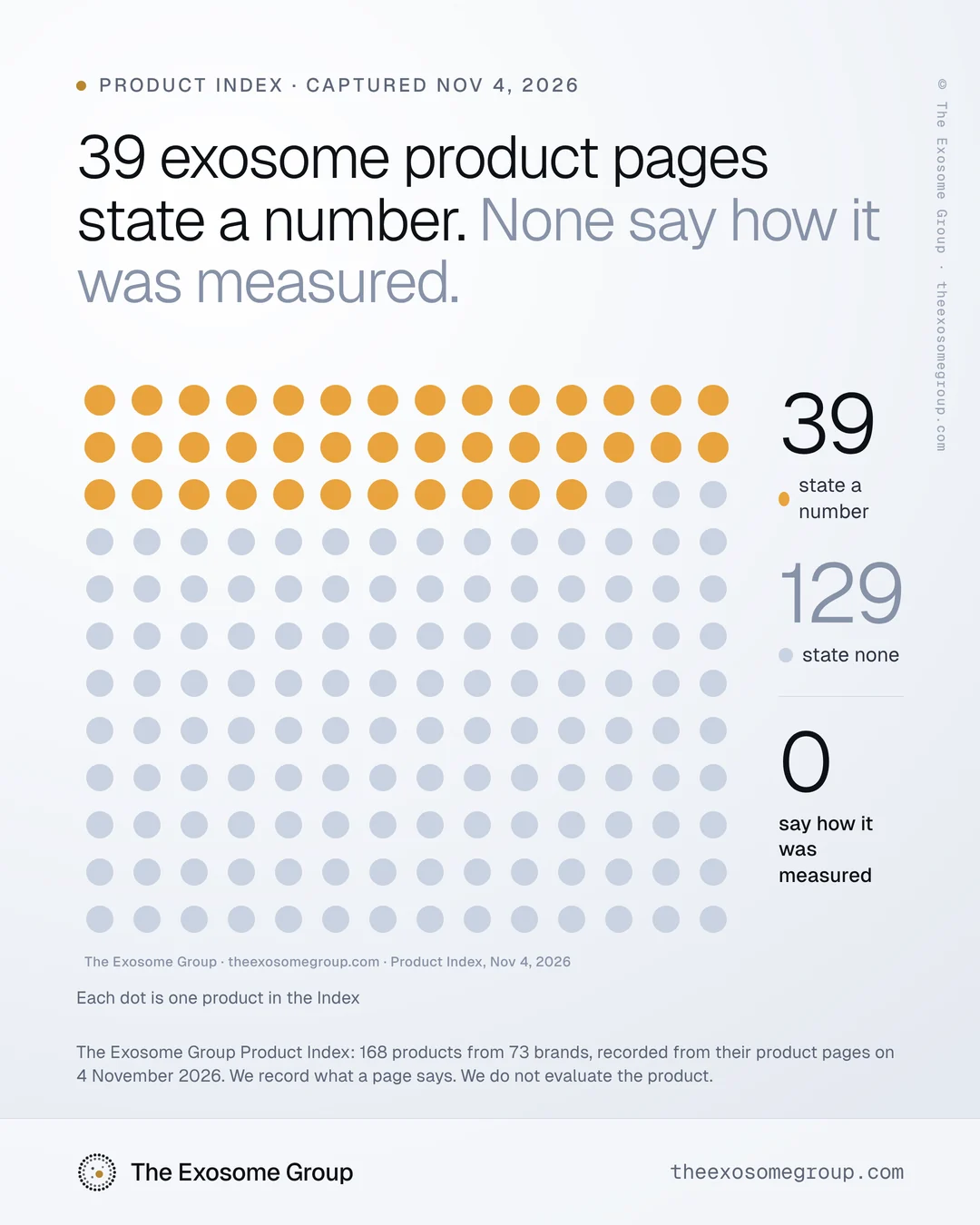
In our Product Index of 168 products from 73 brands, recorded from their product pages on 4 November 2026, 39 pages state a number for vesicle quantity and none of them says how that number was measured. Without the method, the instrument, the dilution, the blank, the lot and the date, a count can’t be checked, repeated or compared with any other count, including the next lot of the same product.
Do exosome product pages say how their numbers were measured?
Not on the pages we recorded. We read 168 product pages that use exosome or extracellular vesicle wording, across 73 brands, and recorded what each one says about vesicle quantity. 39 pages put a number on it. We then looked on those 39 pages for any line naming an instrument, a method, a dilution, a lot or a date of measurement. We found none.
This is a finding about pages, not products. A product can be well made and still sit on a page that leaves its method out. A method may exist in a supplier file the public never sees. What the page gives a buyer, a retailer or a customer is the number on its own, and the number on its own is what gets repeated in listings, reviews and sales decks.
What kinds of numbers do exosome product pages state?
The 39 numbers are not all the same kind of number, which is the first problem. Sorted by what they are, they fall into four groups.
| What the page states | Pages | What it describes |
|---|---|---|
| A percentage | 12 | A share of a named ingredient or complex in the formula |
| A ppm figure | 3 | A concentration of a named ingredient, not a count |
| A figure that reads as a particle count | 22 | Particles in some amount of product, by a method the page doesn’t name |
| A word such as “billions,” with no figure | 2 | Nothing that can be checked |
Only the third group tries to say how many vesicle-sized particles are present. A percentage or a ppm figure describes how much of an ingredient went in. It says nothing about how many vesicles that ingredient carries, and the two can’t be converted without a measured count for the ingredient itself. We cover the units in Three units, three measurements.
The gaps stack up. Of the 22 counts, 10 don’t say what the count is per: not per bottle, not per mL, not per dose. And 15 of the 39 pages that state a number are recorded with no specified source: nothing on the page places the vesicles’ origin as plant, milk, microbial, human-derived, another animal or human cell, or synthetic.
Why does an exosome count need a method?
Because a particle count is not a fact about a product. It is the last line of a measurement, and every line above it can change the result.
The method decides what counts as a particle. Nanoparticle tracking analysis, one common method, follows particles moving in a liquid and reports how many it sees in a size window. In its usual light-scatter mode it can’t tell a vesicle from a protein aggregate, a lipoprotein or a droplet of the same size. What a particle count counts goes through that gap.
The method also moves the number. In a 2026 study, vesicle materials from two cell sources were measured by three methods that report concentration: particle tracking analysis, asymmetric flow field-flow fractionation and microfluidic resistive pulse sensing. Particle concentrations differed by up to two orders of magnitude across methods and cell sources (Poudel et al., Biomolecules, 2026), before anyone asks what is in a bottle.
MISEV2023, the reporting guidance from the International Society for Extracellular Vesicles, is plain about this. It calls particle number concentration “often unreliable, since many techniques lack specificity for EVs,” and asks studies to report the method’s limit of detection. For nanoparticle tracking analysis, it notes that no traceable limit of detection currently exists. And it notes that reported vesicle concentration in blood plasma spans six orders of magnitude depending on the measurement method.
A note on words. MISEV2023 recommends “extracellular vesicle,” or EV, and keeps “exosome” for vesicles shown to come from the cell’s endosomal system. We use “exosome” when we mean the word on the label, and “vesicle” for the material.
What should a method line on an exosome claim include?
A method line answers five questions. If a document can answer them, a second party can read the number. If it can’t, nobody can check it: not the buyer, not the retailer and not the brand.
- Which method and instrument produced the number?
- What dilution was used, and in what liquid? The concentration on the page is back-calculated from it.
- Was a blank run, and what did it read? A blank shows what the instrument reports when no vesicles are present.
- Which lot was measured?
- On what date?
A full study reports more than this, including the instrument settings and a size distribution rather than a single figure. These five are the floor for any number that leaves the lab. Five lines behind every particle count turns them into a checklist for a supplier document, with the limit of detection added and the lot and date read as one line.
How did we count?
It seems fair to show our own method line. The Product Index records 168 products from 73 brands, from product pages that use exosome or extracellular vesicle wording on retailer listings, brand sites and ingredient supplier sites, captured on 4 November 2026. Pages from businesses owned by our founder were excluded. Each row records only what the cited page says. A script checked that every recorded number appears word for word on the page it came from. We publish distributions, never rows, so no brand, product or page is named here.
One limit on the method finding: one page marks its count with a footnote whose text we did not capture. Every other page that states a number was read in full for a method line.
The Index is a snapshot. Pages change, and some sites could not be read on the day. The figures here describe those 168 pages on that date.
Is the missing method only a product page problem?
No. A 2026 scoping review in Aesthetic Surgery Journal examined the first 20 cosmetic products returned by an online shopping search for exosomes and reported that they carried minimal information on how the exosomes were isolated or processed, or on shelf life (Knauer et al., 2026). Our Index is larger and narrower, since it records only what each page says about vesicle quantity, and the gap looks the same.
Consumers and practitioners aren’t asking about it much yet, either. Of 126 consumer and practitioner posts and questions we collected on 5 November 2026, 6 asked about the numbers on the label. The number gets read. The method behind it rarely gets asked for.
What this finding does not tell you
- Whether any product contains vesicles, or how many. We record what a page says. We measured nothing.
- Whether a method exists behind the number. It may sit in a supplier file or a certificate of analysis that isn’t public.
- Whether a product works. That is outside what we do.
- Anything about pages we didn’t record. The Index covers 168 pages captured on one day.
What it does tell you is narrow and useful: on the public page, the number arrives alone.
What to ask for
If you buy, sell or stock a product with an exosome number on it, ask for the document behind the number before anything else. Specifically:
- The method and the instrument, named
- The dilution and the diluent
- The blank, and what it read
- The lot number and the date of measurement
- Whether it was measured on the raw ingredient or the finished product
- What the count is per
If the supplier can send those, the number becomes something a second reader can check. If it can’t, that is worth knowing before the number reaches your label.
We record what a page says. We do not evaluate the product.
Have a number on your own label, or a supplier document, you’d need to defend? Email hello@theexosomegroup.com.
Last reviewed . General scientific information about measurement. Not legal or regulatory advice, and not an assessment of any product.
Sources
- The Exosome Group Product Index: 168 products from 73 brands, recorded from their product pages on 4 November 2026. Each product’s page uses exosome or extracellular vesicle wording. Published as distributions only; no brand, product or page is named.
- Poudel S et al. Intermethod characterization of commercially available extracellular vesicles as reference materials. Biomolecules. 2026;16(1):66. PMID 41594606.
- Welsh JA et al. Minimal information for studies of extracellular vesicles (MISEV2023). J Extracell Vesicles. 2024;13(2):e12404.
- Knauer G et al. Clinical evidence and commercial landscape of topical exosomes for skin rejuvenation: a scoping review. Aesthet Surg J. 2026;46(11):NP148-NP157. PMID 42411735.