In short
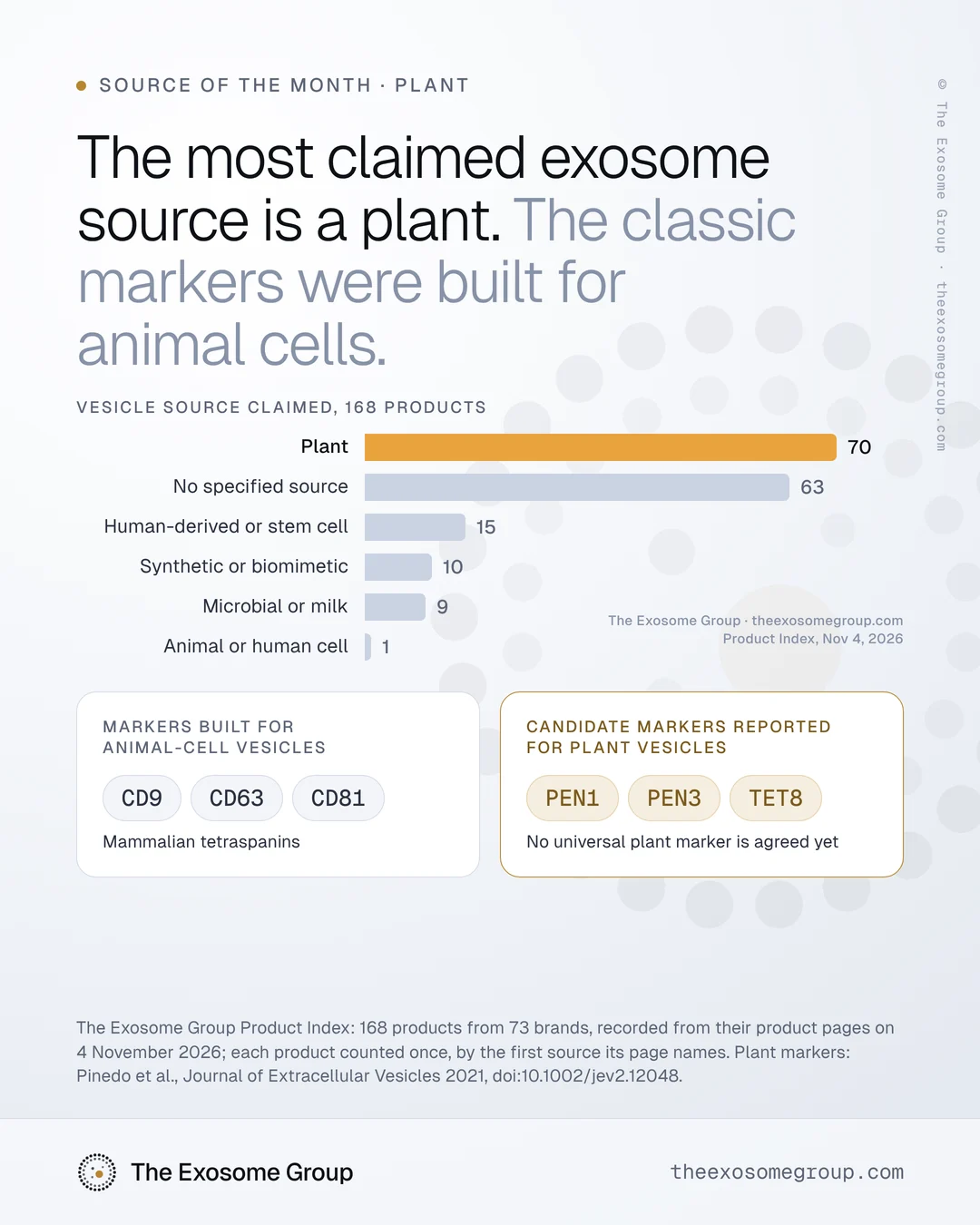
CD9, CD63 and CD81 are mammalian tetraspanins, the classic markers for vesicles from animal cells, and they are the wrong first question for a plant preparation. Plants have their own candidate markers, including PEN1, PEN3 and TET8, and no universal plant vesicle marker has been agreed. So a negative CD63 result on a plant ingredient is the expected outcome, not a failure, and a CD63 result offered as proof for a plant source answers a question that doesn’t apply.
What is the most common exosome source on product labels?
A plant. In our Product Index of 168 products from 73 brands, recorded from their product pages on 4 November 2026, 70 pages claim a plant source. No other named source comes close; the next is human-derived or stem cell, at 15. A larger group, 63 pages, is recorded with no specified source.
Our rule: a page gets a source when its wording places the origin in a class we can name: plant, milk or colostrum, microbial, human-derived or stem cell, another animal or human cell, or synthetic. Umbilical cord, platelet, and human or mesenchymal stem cell wording counts as human-derived, even when no species is given. Plant stem cell wording counts as plant. A named cell type with no species, such as fibroblasts, counts as an animal or human cell. A branded complex, an unplaced extract or the word “exosomes” alone does not name a source.
| Vesicle source claimed | Products |
|---|---|
| Plant | 70 |
| No specified source | 63 |
| Human-derived or stem cell | 15 |
| Synthetic or biomimetic | 10 |
| Microbial or microalgae | 7 |
| Milk or colostrum | 2 |
| Animal or human cell, species not stated | 1 |
17 of the 70 name no plant on the page; 3 more don’t name it in the passage we recorded. The plant named most often is centella asiatica, also sold as cica, which appears on 25 of the 70.
What are CD9, CD63 and CD81?
They are tetraspanins, a family of proteins that sit in cell membranes. In mammalian vesicle research they are the classic markers: a western blot or another antibody-based test that finds them is a common line of evidence that a preparation contains vesicles from animal cells. The antibodies sold to detect them are made against mammalian proteins.
That is why they turn up on supplier documents. They are the markers most labs know, and the antibodies are widely sold. Neither fact makes them the right markers for a plant.
Which markers have been proposed for plant exosomes?
Plants make vesicles with their own proteins. A 2021 call for rigor in plant vesicle research, by Pinedo and colleagues in the Journal of Extracellular Vesicles, names three candidate membrane (category 1) markers:
- PEN1, a syntaxin
- PEN3, an ABC transporter
- TET8, a plant tetraspanin
The same authors also name two cytosolic proteins, PATL1 and PATL2, as putative markers, because they were found enriched in vesicles that plant cells release.
Work in Arabidopsis has tied TET8 to vesicles that plant cells release (Cai et al., Science, 2018). So plants do have tetraspanins of their own. They are not CD63.
These are candidates. The same authors say an ideal plant marker should also be conserved across plant species, and none has been agreed as universal. They also note a practical limit: most antibodies raised against the plant candidates were not yet commercially available when they wrote. A supplier that says it ran a plant marker panel should be able to name the reagent.
What does a negative CD63 result on a plant preparation mean?
Very little about the plant material. CD63 is a mammalian protein, detected with antibodies made against mammalian proteins. A negative result on a plant preparation is the expected outcome of running an animal-cell test on a plant. It is not evidence that vesicles are absent.
A positive result needs more thought, not less. If a mammalian tetraspanin test lights up on a plant preparation, the first question is about the assay: what the antibody bound to, and how the test was controlled. On its own, it doesn’t show that the preparation is what the label says.
| Marker | Built for | What a result on a plant preparation shows |
|---|---|---|
| CD9, CD63, CD81 | Vesicles from mammalian cells, detected with antibodies made against mammalian proteins | A negative is expected. A positive is a question about the assay, not a confirmation |
| PEN1, PEN3, TET8 | Candidate markers for plant vesicles | Supporting evidence, if the reagent is named. None is agreed as universal |
Either way, a CD63 result offered as proof for a plant source answers a question that doesn’t apply. The source decides the method, and it decides the marker question before a single result is read. Our shorter note, Plant vesicles and CD63, covers the core of this.
Is it a plant exosome or a plant-derived nanovesicle?
This distinction matters as much as the marker. Pinedo and colleagues recommend “plant EVs” for vesicles that plant cells release naturally, and “plant-derived nanovesicles” for material recovered by blending, grinding or pressing tissue, where natural release can’t be shown.
The two are not interchangeable. The same authors note that only a small share of the proteins found in nanovesicles made from ground leaves also turn up in vesicles collected from the fluid between leaf cells. Material made by breaking tissue carries what was inside the broken cells.
On the word itself: MISEV2023, the field’s guidance from the International Society for Extracellular Vesicles, recommends “extracellular vesicle” and discourages “exosome” unless the vesicles are shown to come from the cell’s endosomal system. For plant material made by blending or pressing, neither “exosome” nor “plant EV” describes how it was made. “Plant-derived nanovesicle” does.
Does MISEV2023 cover plant vesicles?
Only in general terms. MISEV2023 has source sections for bacteria and for milk, among others, and none for plants. It mandates no particular marker and states that no single technique is absolutely required. Its marker table lists proteins found in mammalian vesicles, and notes that other proteins in the same categories may be equally valid for non-mammalian sources, including plants. It describes its basic principles as most likely applicable to all vesicle sources.
Read together, that leaves a plant ingredient with principles but no checklist. The principles still apply: show identity with markers suited to the source, estimate what else came along with the vesicles, and state the limits of each method. The markers have to come from plant biology, not from a mammalian panel.
What would identity evidence for a plant preparation look like?
Not one test. MISEV2023 asks for at least one protein from each of three groups: a membrane protein associated with vesicles, a protein found inside vesicles, and a major component of the non-vesicle material that tends to come along, used as a purity check. Its examples are mammalian proteins, but the logic carries over to any source: something that should be there, something that should be inside, and something that shouldn’t be there at all.
For a plant preparation, that points to a candidate plant marker with the reagent named, images by electron microscopy showing membrane-bound vesicles, an estimate of what else was recovered, and a plain statement of whether the material is a plant EV or a plant-derived nanovesicle. No single item settles it. Together they let a reader see what was shown and what wasn’t.
What to ask a plant ingredient supplier
The first question isn’t “what’s the count?” It’s “what was it tested for, and was that test built for this source?” In practice, ask for:
- The plant, by species and tissue, and the document that states it
- Whether the material was released by living cells or recovered by blending, grinding or pressing
- Which identity markers were tested, with the reagent named, and what result was expected before the test was run
- What else came along with the vesicles, and how that was estimated
- Whether any CD9, CD63 or CD81 result appears in the file, and why it was run
- Which lots were tested, and on what dates
A supplier who can answer those has thought about the source. A file built on a mammalian panel alone is worth a second read before it supports a plant claim.
What this does not tell you
- Whether any plant ingredient contains vesicles. We measured nothing.
- Whether one source is better than another. The source decides the method. It doesn’t rank the material.
- Whether a product works. That is outside what we do.
We record what a page says. We do not evaluate the product.
Want the marker question worked through for your own source or supplier document? Email hello@theexosomegroup.com.
Last reviewed . General scientific information about measurement. Not legal or regulatory advice, and not an assessment of any product.
Sources
- The Exosome Group Product Index: 168 products from 73 brands, recorded from their product pages on 4 November 2026. Each product’s page uses exosome or extracellular vesicle wording. Published as distributions only; no brand, product or page is named.
- Pinedo M et al. A call for rigor and standardization in plant extracellular vesicle research. J Extracell Vesicles. 2021;10(6):e12048.
- Cai Q et al. Plants send small RNAs in extracellular vesicles to fungal pathogen to silence virulence genes. Science. 2018;360(6393):1126-1129.
- Welsh JA et al. Minimal information for studies of extracellular vesicles (MISEV2023). J Extracell Vesicles. 2024;13(2):e12404.