In short
A particle count on a certificate of analysis or spec sheet should arrive with five lines: the method and instrument, the dilution and diluent, the limit of detection, the lot and date, and the blank with its reading. Without them, nobody can repeat the measurement or tell how much of the count could be background. The count also needs its basis, per mL, per gram or per unit, and 10 of the 22 particle counts in our Product Index give none.
Why is a particle count the last line of a measurement?
A count looks like a property of a product. It is really the output of a procedure. A sample was taken from one lot, diluted into a liquid, run on an instrument with particular settings, compared with a blank, and back-calculated to the original concentration, on one date. Change any step and the number changes.
That is why the lines above the count matter more than the count. They are what lets a second reader repeat the work, or at least understand it. When we searched how to read an exosome certificate of analysis on 5 November 2026, every first-page result came from a supplier or a treatment provider. The Exosome Group sells no ingredients and no treatments; our founder’s other businesses are listed on our disclosures page.
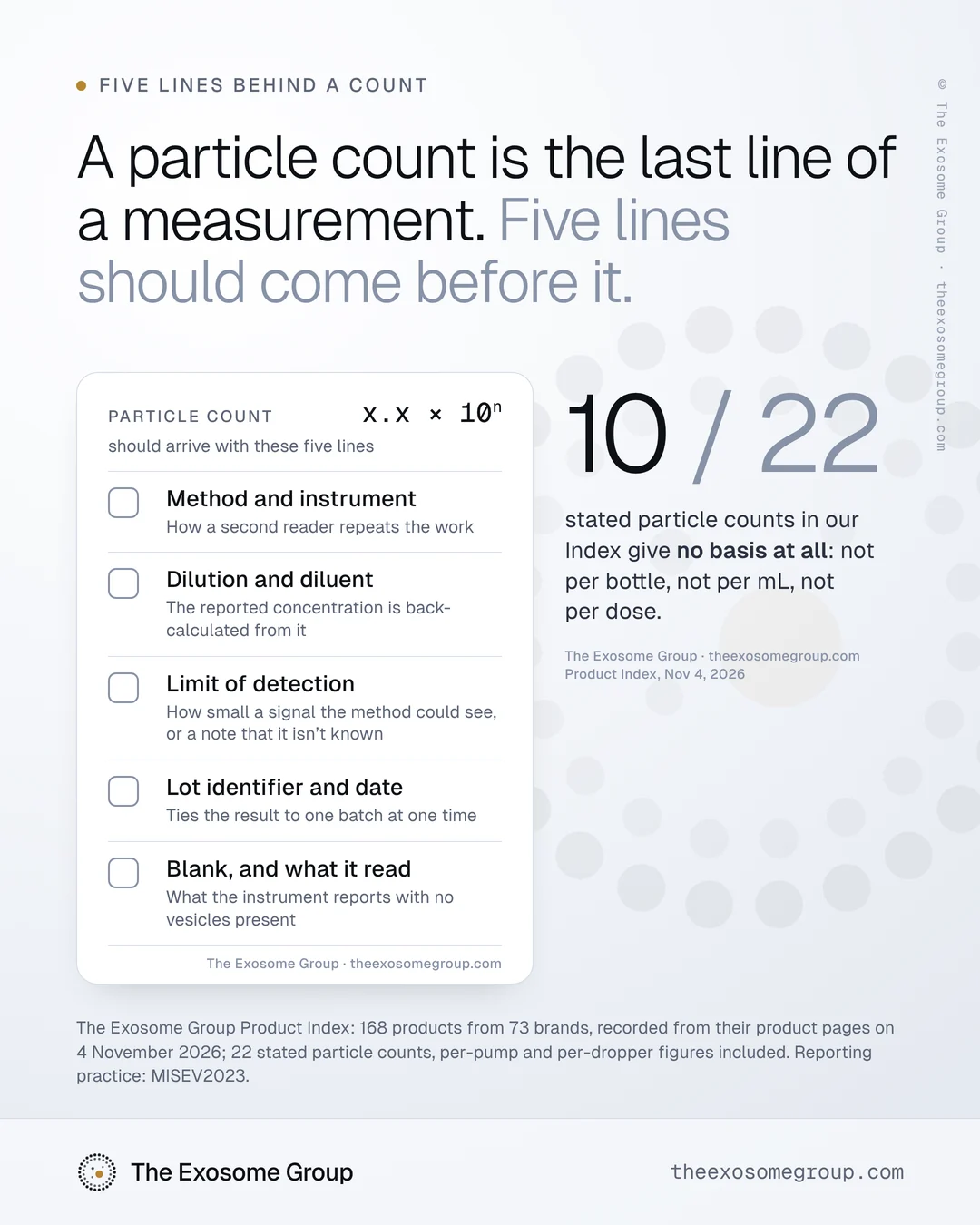
Line 1: which method and instrument produced the number?
Name both. “NTA,” short for nanoparticle tracking analysis, is a method. The instrument model, the software version and the analysis settings decide what the method actually saw. MISEV2023, the reporting guidance from the International Society for Extracellular Vesicles, lists the instrument model, camera settings, laser wavelength and power, software version and analysis settings among the details to report for nanoparticle tracking.
The method matters because it moves the number. In a 2026 study that measured the same vesicle materials by three methods that report concentration, particle concentrations differed by up to two orders of magnitude across methods and cell sources (Poudel et al., Biomolecules, 2026). MISEV2023 notes that reported vesicle concentration in blood plasma spans six orders of magnitude depending on the measurement method. Without the method, a reader has no way to place the figure.
Line 2: what dilution and diluent were used?
Particle counters read accurately only within a working range of concentrations, so samples are usually diluted before they are read. The concentration on the document is then back-calculated: the instrument’s reading multiplied by the dilution factor. It is a calculation, not a reading. Where possible, MISEV2023 asks for data from a dilution series, to show that the readings sat in the instrument’s linear range.
Both the factor and the diluent belong on the page. The factor lets a reader check the arithmetic and see whether the reading sat inside the instrument’s range. The diluent matters because the liquid itself can carry particles, which is where the blank comes in.
Line 3: what was the limit of detection?
Every counting method has a smallest particle, or weakest signal, it can see. Particles below it go uncounted, and the reported size and concentration shift with it. MISEV2023 asks studies to report the assay’s limit of detection. It also recommends reporting a size distribution rather than a single size figure, because summary statistics from nanoparticle tracking “are easily skewed by the LOD.”
There is a catch worth knowing. MISEV2023 also notes that no traceable limit of detection currently exists for nanoparticle tracking analysis. So a careful document won’t print one authoritative figure here. It states how the detection threshold was set, or says plainly that the limit isn’t known.
Line 4: which lot, and on what date?
A result belongs to one batch at one moment. One lot measured once shows what that sample measured on that day. It says nothing about the next lot, or about the same lot six months later.
This is why we treat three lots as the floor behind a label claim. That is our working rule, not a regulator’s. Three lots give a first look at how much the number moves between batches, which is the variation a label claim has to survive. The date ties the number to a point in shelf life, and What one stability time point shows covers what a single date can and can’t support.
Line 5: was a blank run, and what did it read?
A blank is the same measurement with no vesicles in the sample. For a raw ingredient, that usually means the buffer or diluent alone. For a finished cream or serum, it means the same formula without the vesicle ingredient, carried through the same dilution and preparation. MISEV2023 recommends a buffer-only control for nanoparticle tracking analysis.
This is the line most buyers have never asked for, and it is the one that shows how much of a count could be background. Buffers can hold particles. Formulas can hold droplets, micelles and other structures in the same size range as vesicles. Without a blank, there is no way to attribute a count to the vesicle ingredient rather than to everything else in the bottle.
What is the count per?
The five lines describe the measurement. The number also needs a basis: particles per mL, per gram, per bottle or per dose. Those are four different quantities, and they convert only if the fill volume, the dilution and the dose are all stated.
Product pages often skip even this. In our Product Index of 168 products from 73 brands, recorded from their product pages on 4 November 2026, 22 pages state a figure that reads as a particle count. Their bases break down like this:
| Basis stated with the count | Counts |
|---|---|
| Per bottle, vial or jar | 10 |
| Per pump | 1 |
| Per dropper | 1 |
| No basis at all | 10 |
A per-pump figure and a per-bottle figure can’t be compared without knowing how many pumps are in the bottle. A figure with no basis can’t be compared with anything. We go further into units in Three units, three measurements, and into the range of the counts in The spread in stated particle counts.
Where should the five lines appear?
On the certificate of analysis, or on a method summary that travels with it, for every lot. A spec sheet that gives a typical value without these lines is describing a target, not a result. If the lines live in a separate report, the certificate of analysis should name that report so the two can be read together.
The research field has a similar habit. EV-TRACK’s EV-METRIC scores the share of nine reporting items a published study includes, and EV-TRACK says the score reflects reporting transparency, not study quality (Van Deun et al., Nature Methods, 2017). The five lines work the same way. They make a count readable. They don’t make it good.
What do the five lines still not tell you?
A complete set of lines makes a count readable. It doesn’t make it a vesicle count. Light scatter and similar methods count particles in a size window. Identity markers, electron microscopy and an estimate of what else came along are what show how many of those particles are vesicles, or extracellular vesicles in the field’s preferred term. MISEV2023 keeps “exosome” for vesicles shown to come from the cell’s endosomal system, which a count alone never shows. What a particle count counts covers that gap.
The lines also don’t say whether a count measured on the raw ingredient holds in the finished product, and they say nothing about whether a product works.
What to ask for
When a supplier sends a particle count, send back one request: the five lines, plus the basis. In full:
- The method and instrument, with the software version and settings
- The dilution factor and the diluent
- The limit of detection, or a statement that it isn’t known
- The lot identifier and the date of measurement
- The blank: what was in it, and what it read
- The unit with its basis, and whether it was measured on the raw ingredient or the finished product
A document either carries these lines or it doesn’t. What it can support depends on which ones are there.
We record what a page says. We do not evaluate the product.
Have a certificate of analysis on your desk you’re not sure how to read? Send it to hello@theexosomegroup.com.
Last reviewed . General scientific information about measurement. Not legal or regulatory advice, and not an assessment of any product.
Sources
- The Exosome Group Product Index: 168 products from 73 brands, recorded from their product pages on 4 November 2026. Each product’s page uses exosome or extracellular vesicle wording. Published as distributions only; no brand, product or page is named.
- Welsh JA et al. Minimal information for studies of extracellular vesicles (MISEV2023). J Extracell Vesicles. 2024;13(2):e12404.
- Poudel S et al. Intermethod characterization of commercially available extracellular vesicles as reference materials. Biomolecules. 2026;16(1):66. PMID 41594606.
- Van Deun J et al., EV-TRACK Consortium. EV-TRACK: transparent reporting and centralizing knowledge in extracellular vesicle research. Nat Methods. 2017;14(3):228-232. PMID 28245209.