In short
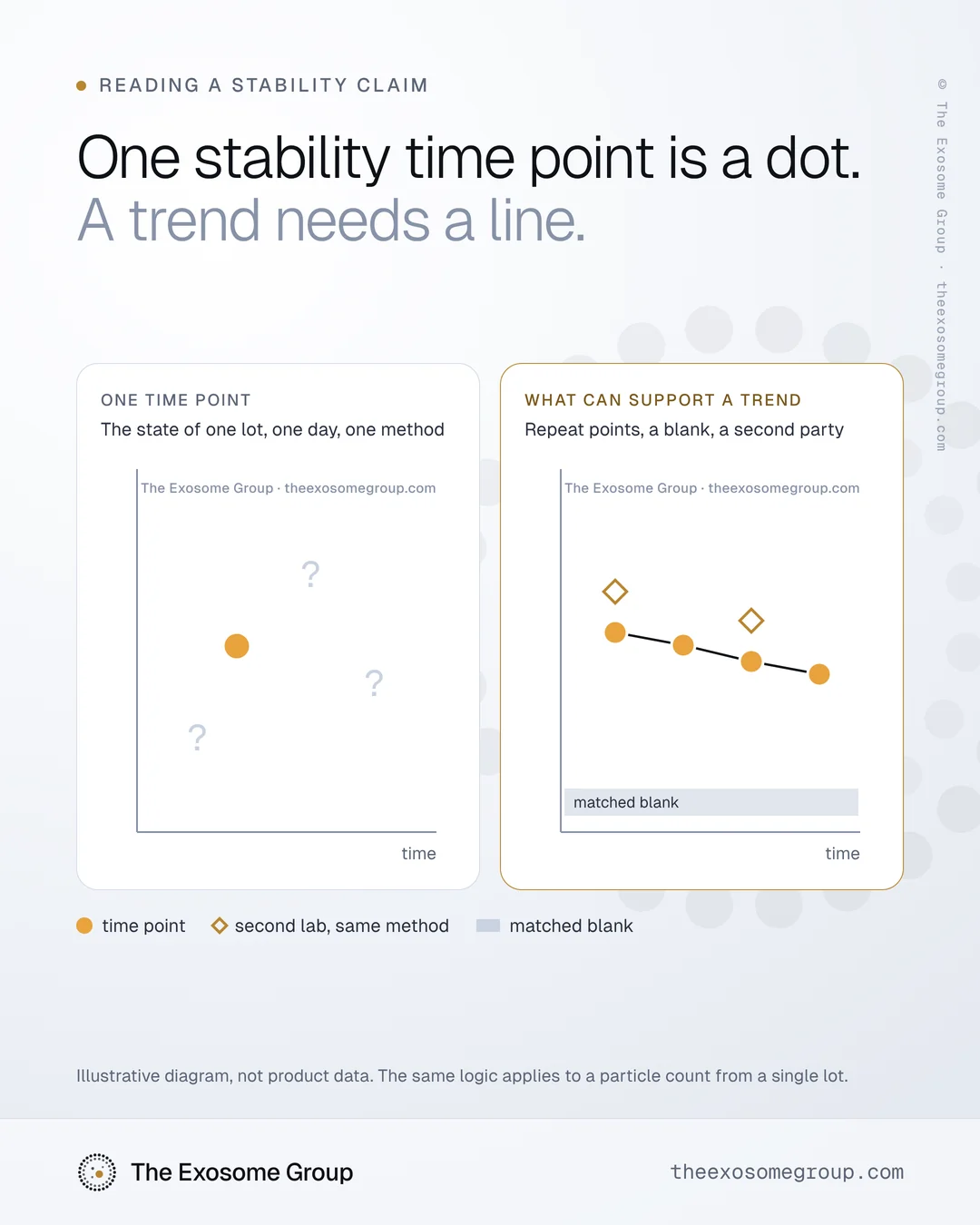
One stability time point tells you the state of one lot of one formula, at one moment, under one set of storage conditions, measured by one method. It shows no trend, says nothing about the end of shelf life, and doesn’t carry over to another lot or formula. A stability claim needs repeat time points on the same lot by the same method, a matched blank at each point, and ideally a second party running the same method.
What does a single stability time point measure?
Exactly what it says: the state of a sample at one time. For a vesicle ingredient or a finished product, that usually means a particle count and a size distribution, sometimes a marker result, taken on a stated date after the product was made and stored under stated conditions.
Where that time point sits changes what it can support. A measurement at release shows what was measurable at release. A measurement at one later point shows what was measurable at that point, under those storage conditions, by that method. Neither describes the product at the end of its shelf life.
Stability is also where public information is thinnest. A 2026 scoping review in Aesthetic Surgery Journal reported that the commercial exosome cosmetics it examined carried minimal information on shelf life, as well as on how the exosomes were isolated and processed (Knauer et al., 2026).
Why can’t one stability time point show a trend?
Because a trend is a relationship between points, and one point has nothing to relate to. A count at month six could sit on a flat line, on a falling line, or on a line that dropped early and then leveled off. The single point looks the same in all three cases. Anything said about the months before it or after it is an assumption, and should be labeled as one.
The same goes for extrapolation. A claim about month 24 that rests on a measurement at month 6 is a forecast, not a result.
What can change a vesicle count between time points?
More than most buyers expect, and not only in one direction. A note on terms first: MISEV2023, the reporting guidance from the International Society for Extracellular Vesicles, calls these particles extracellular vesicles, or EVs, and keeps “exosome” for vesicles shown to come from the cell’s endosomal system. Whatever they are called, four things can move the count.
- Storage. MISEV2023 notes that storage conditions may affect vesicle yield and contents. For milk held before its vesicles are separated, it adds that the effects of storage length and temperature have yet to be fully determined. For a finished cosmetic, how vesicles hold up in a given formula is an open question until it is measured.
- Handling. For blood samples, MISEV2023 notes that freezing and thawing can form vesicle-like fragments of cells. A handling step can add counted particles as well as remove them.
- The formula. A vesicle is defined by its lipid membrane. Surfactants can dissolve lipid membranes at high enough concentration, and an emulsion can hold droplets that overlap vesicles in size. Whether a given formula affects the vesicles in it, at its real concentrations, is an empirical question for that formula.
- The method. If the method, instrument or settings change between time points, the counts don’t compare. In one published comparison, particle concentrations differed by up to two orders of magnitude across methods and cell sources (Poudel et al., Biomolecules, 2026), and MISEV2023 notes that reported vesicle concentration in blood plasma spans six orders of magnitude depending on the measurement method.
What makes a stability result stronger?
Three things change what a stability result can support:
- Repeat time points on the same lot, by the same method. Two points make a line, and more points give it a shape. Keeping the method fixed means a change in the count reflects the sample, not the measurement.
- A matched blank at each point. The formula without the vesicle ingredient, stored and measured the same way, shows how much of each count is background, and whether the background itself drifts over time. MISEV2023 recommends a buffer-only control for nanoparticle tracking analysis; for a finished product, the formula without the ingredient is the closer match.
- A second party running the same method. One lab measuring the material shows the result once. A second lab getting the same answer shows it can be repeated.
More lots widen the picture again. One lot followed over time shows how that lot behaved. Three lots followed over time begin to show how the product behaves. We treat three lots as the floor behind a label claim, which is our working rule rather than a regulator’s.
| What you have | What it supports | What it doesn’t |
|---|---|---|
| One point at release | What was measurable at release | Any trend, or shelf life |
| One later point | What was measurable at that point, under those conditions | Anything after that point |
| Repeat points on one lot | How that lot behaved over that time | Other lots or formulas |
| Repeat points on three lots, with blanks | A first look at how the product behaves | Conditions that weren’t tested |
Storage conditions belong beside every point: the temperature, light exposure, the container, and whether the product had been opened. A result without its conditions can’t be repeated, which makes it hard to build on.
Does a count at release describe the product a customer opens?
Not on its own. A count at release describes the product on the day it left manufacturing. The customer opens it weeks or months later, after shipping and storage the release test never saw. If a label count is a release figure, the document behind it should say so, and a stability series should show how far it holds.
The same logic applies to ingredient data. A supplier’s count for the raw ingredient doesn’t describe the ingredient after it is diluted into a finished formula, let alone after a year on a shelf. Five lines behind every particle count covers what should travel with each of those numbers, and Five things to have on file lists release or expiry as part of the unit itself.
Does a stability result carry over to another lot or formula?
No. A stability series describes the lot and the formula it was run on. A new lot can start from a different count. A new formula can treat the vesicles differently, since a change of surfactant, emulsifier, preservative or pH changes the environment they sit in. Each change is a reason to measure again, not a reason to reuse the old line.
The same holds for a particle count from a single lot. One measurement is a point, not a pattern, whichever question it was meant to answer.
What this does not tell you
- How stable any product is. This page is about what a measurement can support. It contains no product data, and the chart is an illustrative diagram.
- What shelf life a product should carry. That depends on the product’s full stability program.
- Whether a product works. That is outside what we do.
What to ask for
When a supplier or a lab sends a stability result, ask for the series behind it:
- Every time point, with dates, not only the latest
- The storage conditions at each point
- The lot number for each series
- The same method and instrument at every point, or a note where they changed
- A matched blank at each point
- Whether any point was run by a second lab
If a stability claim rests on one time point, it is better to know that before someone else asks.
Send us the stability data or measurement you’re trying to interpret: hello@theexosomegroup.com.
Last reviewed . General scientific information about measurement. Not legal or regulatory advice, and not an assessment of any product.
Sources
- Welsh JA et al. Minimal information for studies of extracellular vesicles (MISEV2023). J Extracell Vesicles. 2024;13(2):e12404.
- Poudel S et al. Intermethod characterization of commercially available extracellular vesicles as reference materials. Biomolecules. 2026;16(1):66. PMID 41594606.
- Knauer G et al. Clinical evidence and commercial landscape of topical exosomes for skin rejuvenation: a scoping review. Aesthet Surg J. 2026;46(11):NP148-NP157. PMID 42411735.