In short
Since 21 January 2025, the cosmetic labelling and advertising guidance of Korea’s Ministry of Food and Drug Safety (MFDS), a guidance document rather than a statute, has listed bare 엑소좀 (exosome) and 엑소좀 화장품 (exosome cosmetic) as prohibited wording, because either could suggest material from a human body. 식물 엑소좀 (plant exosome) and 우유 엑소좀 (milk exosome) are given as permissible examples, because the stated origin is outside the human body. The guidance is about origin. It says nothing about whether vesicles are present or how many, and permitted wording is not evidence of either.
Does Korea restrict the word “exosome” on cosmetics?
In its guidance, in part. The entry sits in the MFDS guidance for cosmetic labelling and advertising, 화장품 표시·광고 관리 지침, published as a guidance document (민원인 안내서) rather than as a statute. The exosome entry was added in the revision of 21 January 2025 (안내서-0086-06). It is unchanged in the revision of 14 August 2025 (안내서-0086-07), the current text when we checked on 5 November 2026. The 2024 version of the same guidance doesn’t contain the Korean word for exosome at all, which is how the entry is dated.
What the entry lists as prohibited is wording that could lead a reader to think a product contains a specific human-derived component, with exosomes and liposomes named as examples. The bare word and “exosome cosmetic” are listed as prohibited examples. Wording that states an origin outside the human body, such as plant or milk, is excluded from that list.
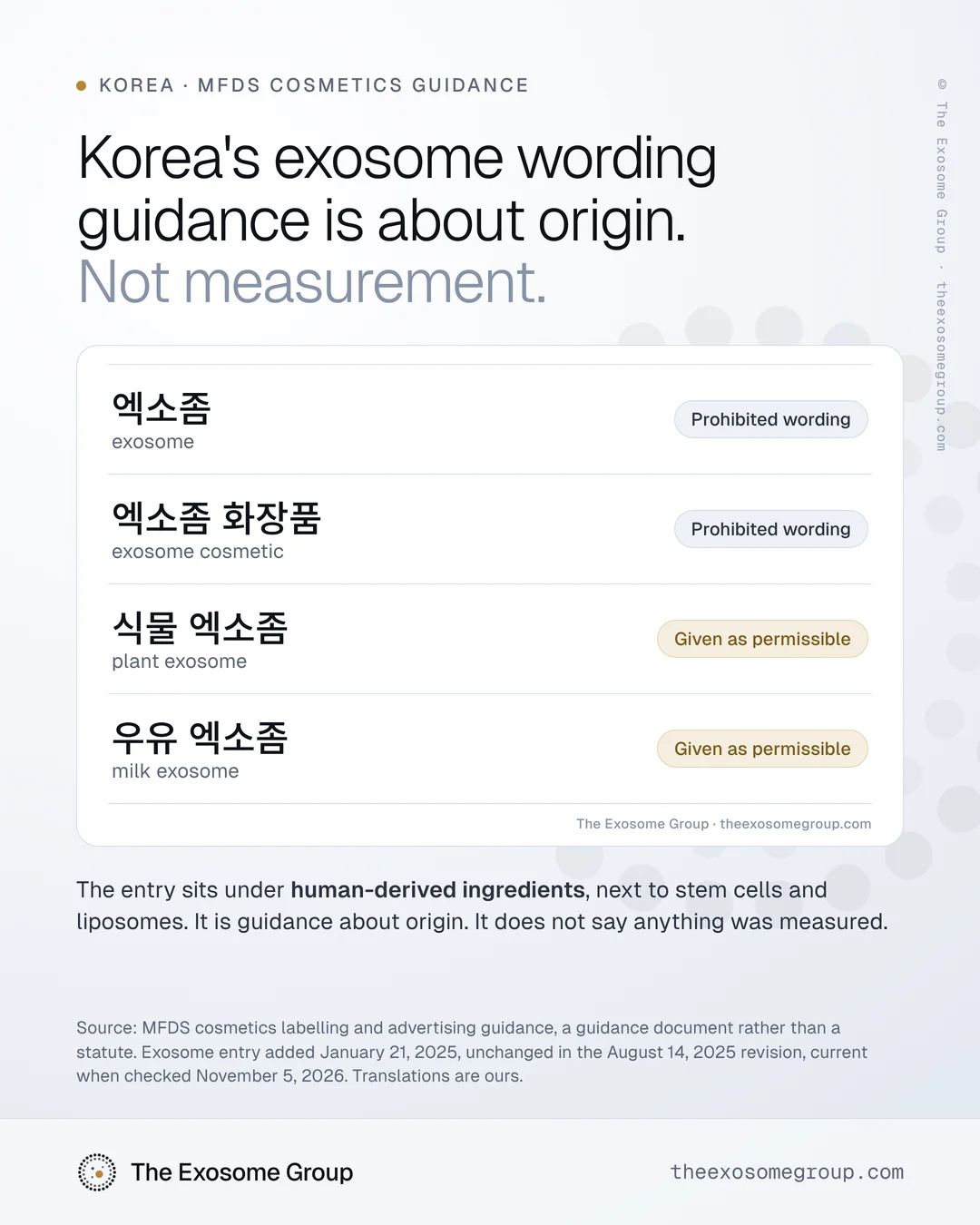
| Wording | Our translation | Listed as |
|---|---|---|
| 엑소좀 | exosome | Prohibited example |
| 엑소좀 화장품 | exosome cosmetic | Prohibited example |
| 식물 엑소좀 | plant exosome | Permissible example |
| 우유 엑소좀 | milk exosome | Permissible example |
Why is the entry filed under human-derived ingredients?
Because that is what it is about. The entry sits in the guidance’s table of prohibited expressions, in a row headed 인체 유래 성분 관련 표현, expressions relating to human-derived ingredients. The same row covers stem cell wording, including a stated number of cells, and lists liposomes beside exosomes. The stated reason for the 2025 amendment, in our translation, is to clarify the prohibited wording for human-derived ingredients.
So plant and milk wording is permitted because the stated origin is outside the human body. Not because plant or milk vesicles are better characterized, and not because anything was measured. Both the prohibited and the permissible lists end in 등, “and the like,” so the named phrases are examples rather than a closed list.
It helps to set this beside the science word. MISEV2023, the reporting guidance from the International Society for Extracellular Vesicles, recommends “extracellular vesicle” and keeps “exosome” for vesicles shown to come from the cell’s endosomal system. The Korean guidance doesn’t draw that line. It is about where the material came from, not how the vesicles formed.
Does “plant exosome” wording mean the regulator confirmed vesicles are present?
No. This is the easiest way to read the guidance backwards. Permitted wording is a statement about which words may appear, given a stated origin. It isn’t a finding that vesicles are in the product, and MFDS doesn’t present it as one.
A brand that writes “plant exosome” on a Korean label has stated an origin. Whether the bottle holds vesicles from that plant, how many, and measured how, are separate questions the wording guidance doesn’t touch. Plant exosomes and animal-cell markers covers what evidence would address the first of them.
Does Korea require proof of an exosome count?
Not in the texts we read. The same guidance has an annex on substantiation, 별표 2, that sets out the claims MFDS treats as needing evidence. Its entries are efficacy and quality claims, and the only one supported by analytical test data is the “free of” claim. None asks a company to show that a named ingredient is present, and none addresses a particle count.
A separate MFDS guidance document on test methods for substantiating labelling and advertising claims, dated November 2024 and 103 pages long, doesn’t mention exosomes at all.
In Korea, then, the exosome question is a wording question, not an evidence question. That is a coherent design for wording guidance. It also means the exosome wording on a Korean label carries no information about measurement, in either direction.
What else in the guidance touches exosome products?
Two more entries in the same table matter for vesicle products that cross borders:
- Needle wording. The guidance lists as prohibited any wording that misdescribes how a product is used, with 마이크로니들 (microneedle) and related needle terms among the examples. MFDS’s press material of 21 January 2025 named microneedle wording alongside the exosome entry.
- Clinic wording. It also lists phrases meaning “for hospital use” and “dermatology clinic only,” such as 병원용 and 피부과전용.
A product sold in more than one market can therefore carry wording abroad that its Korean label could not. That is worth mapping before a label is translated in either direction.
Why does Korea’s guidance matter outside Korea?
Because a large share of the category comes from Korea, and more of it is going to the United States. MFDS reported on 2 October 2026 that Korean cosmetics exports reached USD 11.14 billion in the first three quarters of 2026, up 31.1 percent. The United States was the largest destination, at USD 2.349 billion, 21.1 percent of the total and up 40.6 percent. These figures cover all cosmetics. MFDS publishes no separate line for exosome products.
| Year | US share of Korean cosmetics exports |
|---|---|
| 2022 | 10.8% |
| 2023 | 14.0% |
| 2024 | 18.9% |
| 2025 | 19.7% |
| 2026 | 21.1% |
Korea’s weight shows in our Product Index too. Of its 168 products from 73 brands, recorded from their product pages on 4 November 2026, 44 are from brands based in South Korea, second only to the United States at 65. 14 of those 44 state a number for vesicle quantity, and none says how it was measured, the same as every other page in the Index that states a number.
How do other markets treat the same word?
Differently, and that is where a wording file built for one market needs a second look. In the European Union, Annex II of the Cosmetics Regulation, the list of substances prohibited in cosmetic products, includes entry 416: “Cells, tissues or products of human origin.” Great Britain’s assimilated version of the regulation carries the same entry. Those rules also turn on origin, but they name the material rather than the word.
For a buyer in the United States, the practical point is simpler. A Korean wording file answers a wording question. If a buyer, importer or retailer later asks what a count or a ppm figure refers to, or how it was measured, the wording file won’t answer it. That answer has to come from a measurement file, and Five lines behind every particle count sets out what one should contain.
None of this is legal or regulatory advice. It is a map of where the rules sit, so the right questions reach your regulatory counsel.
What this does not tell you
- Whether any product contains vesicles. Wording guidance doesn’t address that, and we measured nothing.
- Whether a given label meets Korean rules. That is a question for Korean regulatory counsel.
- Whether the guidance has changed since 5 November 2026, when we last checked it.
- Anything a native Korean reader would add. Our translations have not been checked by one.
What to ask for
For an ingredient or product of Korean origin sold elsewhere, ask the supplier for:
- The stated origin of the vesicle material, and the document behind it
- Which market each version of the label and product page was written for
- Whether any wording differs between those versions, and why
- Any number on the label, with its method, unit, lot and date
We record what a page says. We do not evaluate the product.
Mapping exosome wording across markets for your own label? Email hello@theexosomegroup.com.
Last reviewed . General scientific information about measurement. Not legal or regulatory advice, and not an assessment of any product.
Sources
- Ministry of Food and Drug Safety (MFDS). 화장품 표시·광고 관리 지침 (guidance on cosmetic labelling and advertising; a guidance document, 민원인 안내서), revision 안내서-0086-07, 14 August 2025. Exosome entry added at revision 안내서-0086-06, 21 January 2025. Opened 5 November 2026.
- MFDS. 화장품 표시·광고 금지표현 확대 (prohibited expressions in cosmetic labelling and advertising expanded), press reference material, 21 January 2025. Opened 5 November 2026.
- MFDS. 화장품 표시·광고 실증을 위한 시험방법 가이드라인 (test methods for substantiating cosmetic labelling and advertising), November 2024. Opened 5 November 2026.
- MFDS. Cosmetics export statistics for the first three quarters of 2026, press release, 2 October 2026. Opened 5 November 2026.
- Regulation (EC) No 1223/2009 on cosmetic products, Annex II, entry 416. Consolidated text CELEX 02009R1223-20250501. Opened 5 November 2026.
- Regulation (EC) No 1223/2009 as assimilated in Great Britain, Annex II, entry 416. Opened 5 November 2026.
- The Exosome Group Product Index: 168 products from 73 brands, recorded from their product pages on 4 November 2026. Each product’s page uses exosome or extracellular vesicle wording. Published as distributions only; no brand, product or page is named.
- Welsh JA et al. Minimal information for studies of extracellular vesicles (MISEV2023). J Extracell Vesicles. 2024;13(2):e12404.