Summary
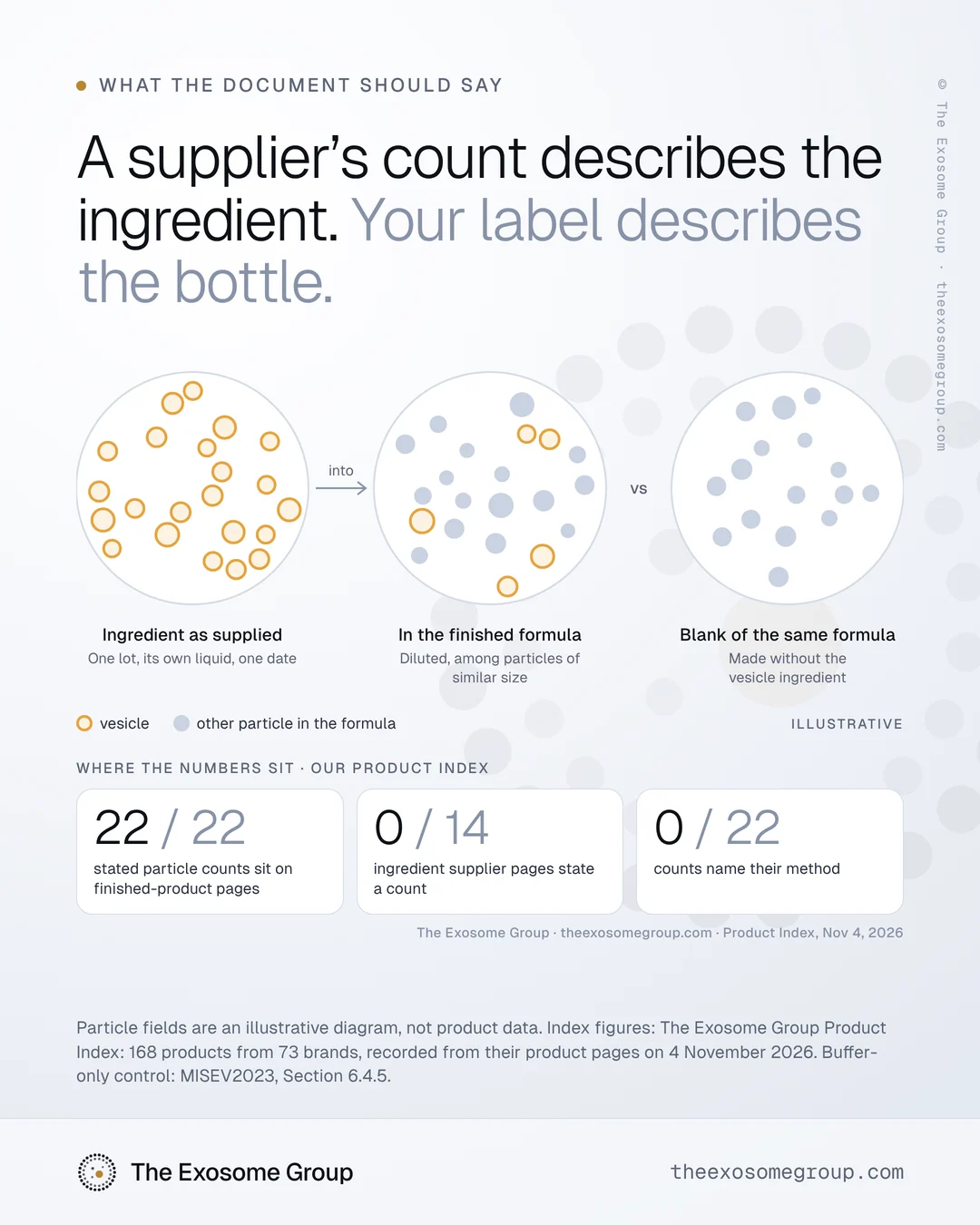
A particle count on a supplier’s document measures the vesicle ingredient as supplied, which at best means one lot, in its own liquid, on one date and by one method. That measurement does not follow the ingredient into a finished formula, where the vesicles are diluted, surrounded by surfactants and oils, and joined by other particles of similar size. A claim about the finished product therefore needs a measurement of the finished product, with a blank of the same formula made without the vesicle ingredient.
What does a supplier’s count describe?
At best, a supplier’s count describes one lot of the raw ingredient, measured in the liquid it is sold in, on a stated date and by a stated method. That number is useful for the supplier’s quality control and for the brand buying the ingredient, and it describes the ingredient on the day it was measured.
Some documents describe less. A spec sheet that gives a typical value without a lot or a date describes a target rather than a result. The five lines that should come with a particle count sets out what should travel with any count.
What happens to the ingredient in a formula?
Once the ingredient goes into a formula, three changes follow that the supplier’s document did not capture:
- The ingredient is diluted. Used at 2 percent of a formula, it is diluted roughly fiftyfold, so whatever vesicles it carried reach the bottle at about a fiftieth of their concentration in the ingredient, at most. Because inclusion rates are usually stated by weight and counts by volume, the conversion is approximate unless the densities are known.
- The vesicles enter a new environment, surrounded by surfactants, emulsifiers, oils, polymers, preservatives, salts and the formula’s pH. MISEV2023 defines extracellular vesicles as particles released from cells and delimited by a lipid bilayer, and in the laboratory surfactant treatment is one way to break vesicles open on purpose; MISEV2023 describes vesicle-disrupting surfactant treatment as a control. Whether a given formula, at its real concentrations, leaves vesicles intact is an empirical question for that formula.
- The formula adds particles of its own. Emulsion droplets, liposomes, polymer particles and other structures in a formula can fall in the same size range as vesicles. A light-scatter particle count measures particles in a size window and cannot tell which of them came from the ingredient.
Can the ingredient count be carried into the bottle?
The ingredient count can be carried into the bottle only as a calculation, and that calculation gives an upper limit. Multiplying the ingredient’s concentration by its inclusion rate gives the most vesicles the bottle could hold if every one survived formulation, filling, storage and shipping intact. The result is not a measurement of the bottle, and it says nothing about shelf life.
| Figure | What it describes | What it does not describe |
|---|---|---|
| Count on the ingredient document | One lot of the ingredient, in its own liquid, on one date, by one method | The ingredient after it enters a formula |
| Calculated count for the bottle | An upper limit: the ingredient count scaled by the inclusion rate | What survived formulation, filling and storage |
| Count measured in the finished product | Particles in the formula, by the stated method, on the stated date | Which particles are vesicles, without a matched blank and identity evidence |
| The same, with a matched blank and identity evidence | A count that can be attributed to the ingredient, for that lot and date | Other lots, other dates, or the end of shelf life |
Why does a finished-product count need a blank?
A finished-product count needs a blank because the formula contributes particles of its own, and a blank is the same measurement made with no vesicles in the sample. MISEV2023 recommends a buffer-only control for nanoparticle tracking analysis, in both light-scatter and fluorescence modes, but that advice was written for research samples, in which vesicles sit in a buffer. In a finished cosmetic the formula takes the place of the buffer, so the closer match is the same formula made without the vesicle ingredient and prepared, diluted and measured the same way.
The difference between the two readings is what can be attributed to the ingredient. The ingredient can also change how the rest of the formula behaves, however, so the blank gives a comparison rather than an exact subtraction.
MISEV2023 also recommends that any method unable to tell vesicles from other particles report a “particle” concentration instead of an “EV” concentration, and in a finished cosmetic a light-scatter count on its own is such a method. Identity evidence, such as markers suited to the source or electron microscopy, is what links particles to vesicles.
Where do the numbers on exosome product pages come from?
The pages do not say. In our Product Index of 168 products from 73 brands, recorded from their product pages on 4 November 2026, all 22 figures that read as particle counts sit on pages for finished products. None of the 14 ingredient supplier pages in the Index, from 5 companies, states a count. None of the 22 says how it was measured, so none says whether it was measured in the finished product or calculated from the ingredient. One page marks its count with a footnote whose text we did not capture.
Supplier counts usually appear in the documents a buyer receives and seldom on public pages, so the question has to be asked of those documents.
Does stability data on the ingredient carry over?
Stability data on the ingredient does not carry over, for the same reason. A stability series on the raw ingredient describes the ingredient in its own liquid, whereas a new formula is a new environment, and a change of surfactant, emulsifier, preservative or pH is a reason to measure again. One stability time point cannot show a trend covers what a stability result can support.
Limits of this note
- Whether any formula damages vesicles depends on the formula and can be answered only by measuring it.
- No product was measured for this note, and it cannot show whether any product contains vesicles, or how many.
- We do not assess whether any product works.
What to request from a supplier
- Whether the count was measured on the ingredient or the finished product
- If the count was measured on the ingredient, the lot, the date, the method, and the inclusion rate used in your formula
- If it was measured on the finished product, the formula and lot measured, the dilution, and a blank of the same formula made without the vesicle ingredient, with what it read
- Identity evidence in the finished product, such as markers suited to the source or electron microscopy
- Any time points after release, with the storage conditions
A supplier’s document can support a statement about the ingredient, but a statement about the bottle needs a measurement of the bottle.
The Index describes what each page says, and it makes no evaluation of the product.
If a supplier’s number is about to go on your label, you can email us first at hello@theexosomegroup.com.
Last reviewed . This note gives general scientific information about measurement and is not legal or regulatory advice or an assessment of any product.
Sources
- Welsh JA et al. Minimal information for studies of extracellular vesicles (MISEV2023). J Extracell Vesicles. 2024;13(2):e12404.
- The Exosome Group Product Index: 168 products from 73 brands, recorded from their product pages on 4 November 2026. Each product’s page uses exosome or extracellular vesicle wording. Published as distributions only; no brand, product or page is named.