Summary
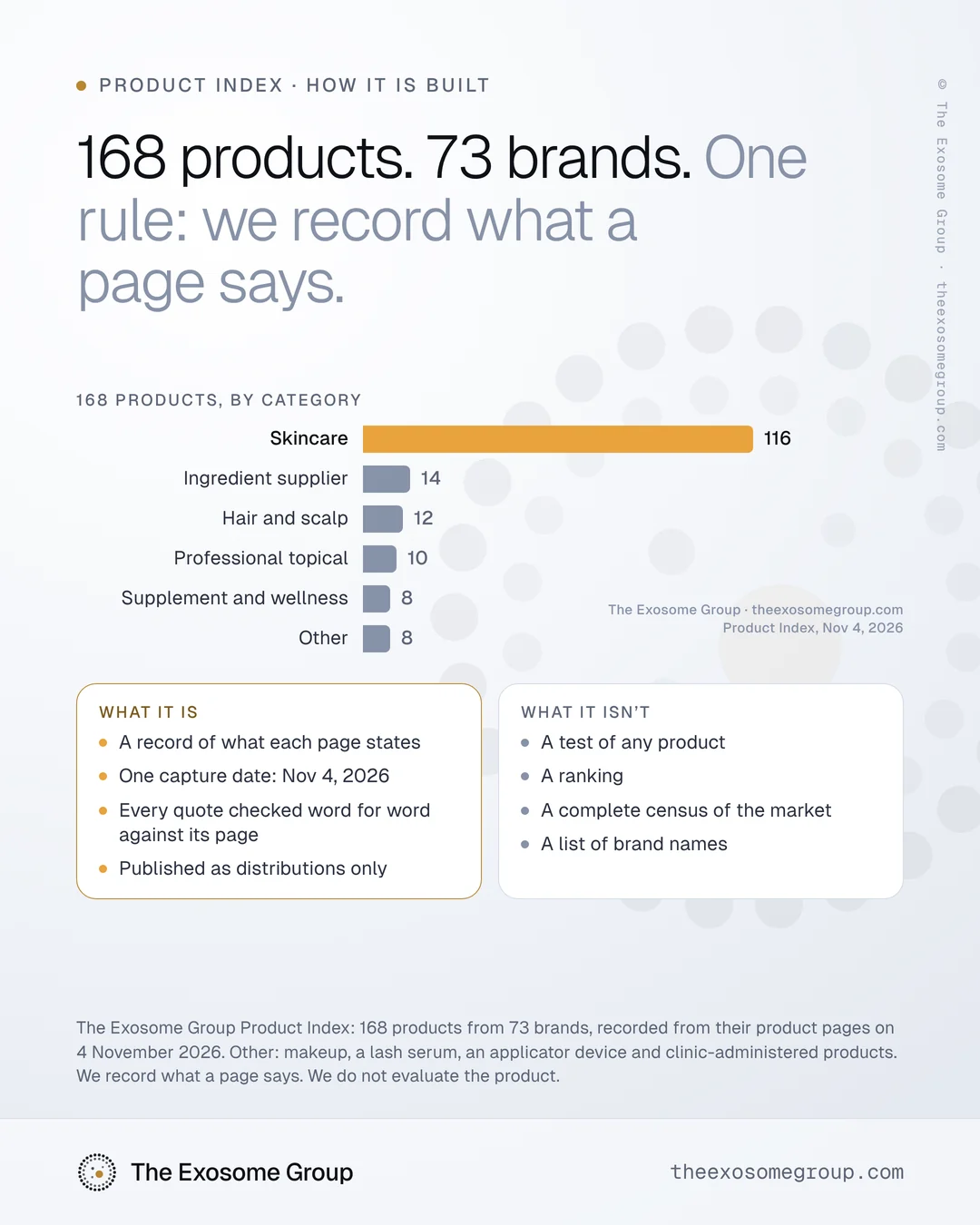
The Exosome Group Product Index is a record of what the pages for 168 products from 73 brands said on 4 November 2026, all of them pages that use exosome or extracellular vesicle wording. Each row records only what its page states, namely the vesicle source claimed, any number for vesicle quantity and its unit, and whether a method is named, and a script checked every recorded quote, phrase and number against its page. The Index is not a test, a ranking or a complete census, and we publish it as distributions and never as rows.
What is the Exosome Product Index?
The Index is a dated record of public product pages. Each row is one product and records what that product’s page says about exosomes or extracellular vesicles, in the page’s own words, on the day we read it. The 168 rows come from 167 page addresses, since two products share one page.
The Index began from the question of what a buyer sees. Most buyers, retailers and customers never read a supplier’s file and read the product page instead, so the Index records that page and nothing behind it.
Which products are in it?
| Category | Products | What it covers |
|---|---|---|
| Skincare | 116 | Serums, creams, masks and other consumer skincare |
| Ingredient supplier | 14 | Pages from 5 companies selling vesicle ingredients to brands |
| Hair and scalp | 12 | Scalp serums and ampoules, a spray, a shampoo and other hair treatments |
| Professional topical | 10 | Sold through licensed professionals, or for use before or after a procedure |
| Supplement and wellness | 8 | Food supplements, including capsules and a sublingual product |
| Other | 8 | Makeup, a lash serum, an applicator device and clinic-administered products |
The distributions count products rather than brands, and some brands contribute many rows, such as a full product line or a supplier’s catalog, so a brand with fourteen products weighs fourteen times as much as a brand with one.
Pages came from brand sites, retailer listings and ingredient supplier sites, found through retailer searches, brand product feeds and supplier catalogs. A page is included if it uses exosome or extracellular vesicle wording, whether or not it says the product contains vesicles. A few do not, because their wording is about something else, such as the skin, and they remain in the Index because the word is what we track. Liposome and other delivery-vesicle wording that is not exosome or extracellular vesicle wording was left out.
What does each row record?
| Field | What it records |
|---|---|
| Vesicle source claimed | The source the page names, such as a plant, milk or human-derived material, or no specified source if it names none we can place |
| Exosome wording | The exact phrases the page uses |
| Quote | A short passage from the page, word for word, up to 25 words |
| Number claimed | Any number for vesicle quantity, as written: a count, a percentage or a ppm figure |
| Unit | What the number is per, where the page says |
| Method stated | Whether the page names how the number was measured |
| Context | Category, brand country, where it is sold and the capture date, filled only where the page or a reliable source shows it |
Every row also cites the page it came from, and prices were noted as shown on the day, although we never publish a price tied to a listing.
How is the Index checked?
Every page was fetched once and kept, and a script then checked each recorded quote, wording phrase and number against the page. The check required each item to appear as continuous text on the cited page, in its visible text or its own product data, and all 168 rows passed. Quotes are short continuous passages, never stitched together from separate sentences, and we changed nothing in them except spacing and punctuation marks.
Counting rules are written down so that each figure can be repeated, and three examples show how they work. A figure stated per pump or per dropper counts as a particle count, which gives 22 counts across the Index, while percentages, ppm figures and “billions” without a figure are not counted among the 22. Umbilical cord, platelet, and human or mesenchymal stem cell wording is coded as a human-derived source even when the page gives no species, and plant stem cell wording is coded as plant. Each product is counted once, by the first source its page names.
Limits of the Index
- We measured no product, so the Index is not a test; each row describes a page, and a page can understate or overstate what is in the bottle.
- No row is scored, and a page that states more is not ranked above one that states less.
- We do not assess compliance or say whether any page meets the rules of any market.
- The record is incomplete, because some large retailers could not be read on the day, products that mention vesicles only in their ingredient lists were not added, and 23 rows have no brand country recorded.
- Pages change after capture, so every figure we publish carries its capture date.
Why we publish only distributions
Our work is about what a measurement can and cannot show, and no single company is its subject. A distribution answers the question a buyer has, such as how often a page names a method, without pointing at a page. Nothing we publish names a brand, product or page, and we avoid any quote or figure that could be searched back to one page. When someone asks about a specific product in public, we answer the general question and take the specific one to email.
Other researchers have examined the same market from different angles. A 2026 scoping review in Aesthetic Surgery Journal examined the first 20 cosmetic products returned by an online shopping search for exosomes. It reported minimal information on how the exosomes were isolated or processed, or on shelf life (Knauer et al., 2026). Our Index is larger and narrower, since it records only what each page says.
Findings from the Index so far
- Of the 168 pages, 39 state a number for vesicle quantity, and none of those 39 names the method behind it, although one page marks its count with a footnote whose text we did not capture. The details are in Exosome product pages give numbers without saying how they were measured.
- A plant source is claimed on 70 pages, and 63 products are recorded with no specified source. Both findings are described in Animal-cell markers are the wrong first test for plant exosomes and More than a third of exosome product pages name no vesicle source.
- The 22 stated particle counts span about 7.5 orders of magnitude, as set out in Stated exosome particle counts range from millions to a hundred trillion.
- None of the 22 counts is stated per mL, as shown in No exosome product page in our Index states its particle count per mL.
How the Index will grow
We plan to recapture the Index on a fixed date and state that date with every figure. The first gaps to fill are the retailers that could not be read, products that name vesicles only in their ingredient lists, and more professional lines and ingredient suppliers.
The Index records what each page says, and it does not evaluate the product behind any page.
If you have questions about how we build the record, you can email us at hello@theexosomegroup.com.
Last reviewed . This note gives general scientific information about measurement and is not legal or regulatory advice or an assessment of any product.
Sources
- The Exosome Group Product Index: 168 products from 73 brands, recorded from their product pages on 4 November 2026. Each product’s page uses exosome or extracellular vesicle wording. Published as distributions only; no brand, product or page is named.
- Knauer G et al. Clinical evidence and commercial landscape of topical exosomes for skin rejuvenation: a scoping review. Aesthet Surg J. 2026;46(11):NP148-NP157. PMID 42411735.