Summary
A particle count needs a basis, such as per mL, per gram, per bottle, per pump or per dose. In our Product Index, 22 pages state a figure that reads as a particle count. Of these, 12 give a basis that is a container or a single application, with 10 per bottle, vial or jar, 1 per pump and 1 per dropper, and the other 10 give none. None of them states a count per mL, the unit a counting instrument reports, so none shows the concentration its figure started from.
The basis of a particle count
A count without its basis is an incomplete unit. Particles per mL of a sample, per gram of an ingredient, per bottle of a product and per dose of a supplement are four different quantities. They can be converted into one another only when the volumes, masses and dose sizes behind them are stated.
Measurement starts with concentration. MISEV2023, the reporting guideline from the International Society for Extracellular Vesicles, describes number concentration as a particle count combined with a volume measurement, in particles per mL. Nanoparticle tracking analysis, one common method, reports the concentration of the sample it measured, back-calculated through any dilution.
Bases stated on exosome product pages
Our Product Index records 168 products from 73 brands, taken from what their product pages said on 4 November 2026. Of the 39 pages that state a number for vesicle quantity, 22 give numbers that read as particle counts, of which 20 call what they count “exosomes” and 2 say “particles.” The basis stated with each count, read from the sentence around the figure, is shown below:
| Basis stated with the count | Counts |
|---|---|
| Per bottle | 6 |
| Per vial | 3 |
| Per jar | 1 |
| Per pump | 1 |
| Per dropper | 1 |
| No basis stated | 10 |
| Per mL | 0 |
| Per gram | 0 |
| Per dose | 0 |
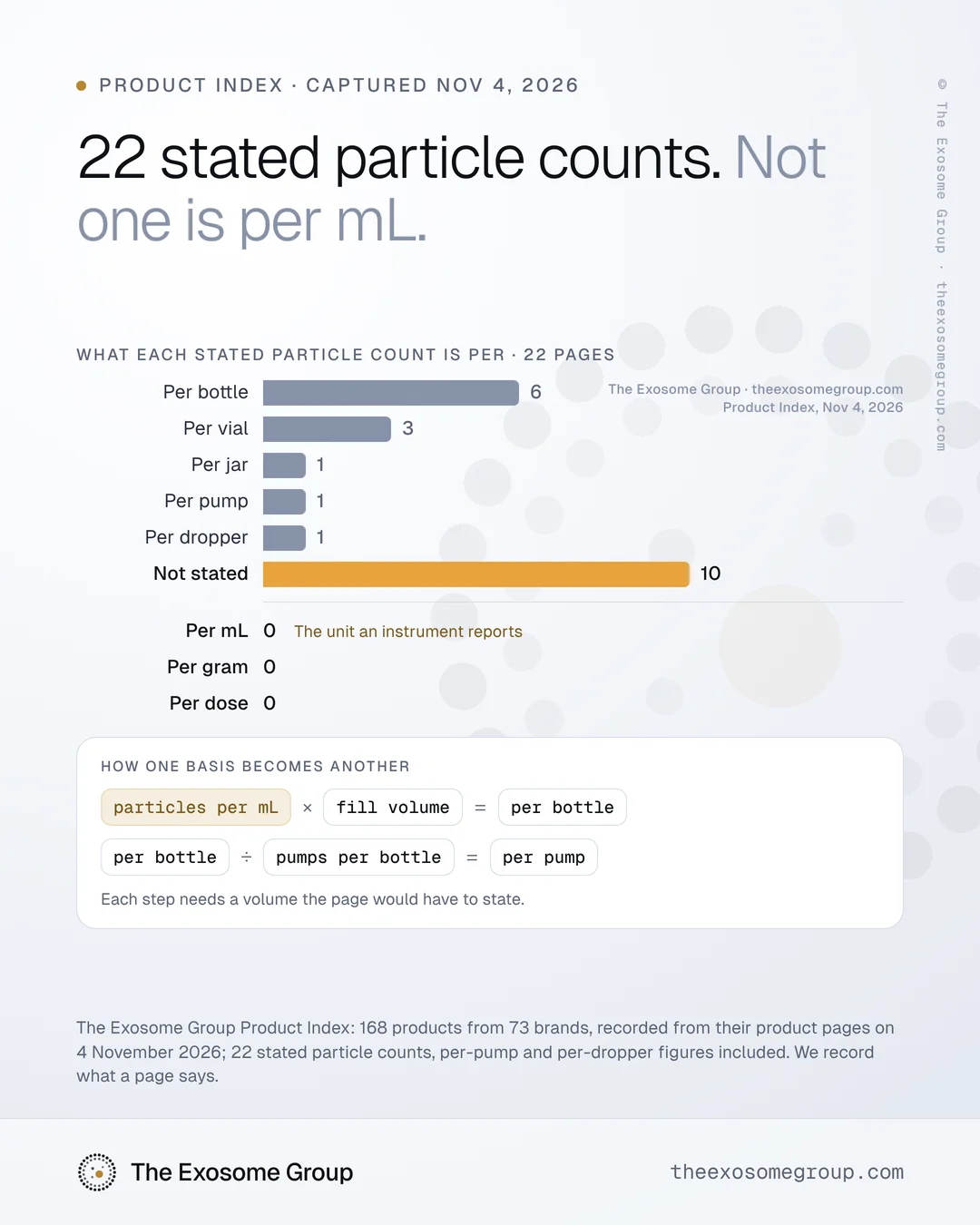
Every basis that does appear is a container or a single application, and no page states the concentration that a measurement would have produced. The other 17 numbers on these pages are not counts at all: they comprise 12 percentages, 3 ppm figures and 2 pages that say “billions” without a figure. Exosome product pages give numbers without saying how they were measured sets them out.
How does a per-mL figure become a per-bottle figure?
Unless someone counted a whole bottle, a per-bottle figure comes from multiplication: a measured concentration in particles per mL, multiplied by a fill volume in mL, gives particles per bottle. Dividing that figure by the number of pumps or doses in the bottle gives particles per pump or per dose, and every step needs a number that the page would have to state.
| To get | You need | What it assumes |
|---|---|---|
| Per bottle | Concentration per mL × fill volume | The fill is what the label says, and the product is uniform |
| Per pump or per dropper | Per-bottle figure ÷ applications per bottle | Every pump or dropper delivers the same volume |
| Per dose | Concentration per mL × dose volume | The dose is defined and delivered the same way each time |
| Per gram | Concentration per mL ÷ density, or a count measured per gram | The density of the cream or gel is known |
Run in reverse, the arithmetic shows why bases cannot be mixed. A per-pump count and a per-bottle count for the same serum differ by the number of pumps in the bottle before anything about the vesicles changes. A per-vial count and a per-bottle count differ by the ratio of their volumes. A count with no basis cannot be placed on this table at all.
Pages rarely show a further step. A concentration measured on a raw ingredient, multiplied by the amount of ingredient in the formula, gives a calculated figure rather than a measurement of the bottle. A supplier’s ingredient count does not describe the finished product covers that gap.
Why per mL is the basis closest to the measurement
A per-mL figure, with its method, lot and date, is the number that a second laboratory could try to repeat. Every other basis is that number carried through arithmetic, and the arithmetic adds assumptions about fill, uniformity and dose.
MISEV2023 also addresses the word in front of the unit. For any technique that cannot tell vesicles from other particles, it recommends that concentration be reported as “particle or EP concentration” and not “EV concentration,” regardless of the separation steps before it, where EP stands for extracellular particle. A page that says billions of exosomes per bottle has therefore made two steps, from particles to exosomes and from a concentration to a container. None of the 22 pages names the method that would let a reader check either one.
Can two particle counts be compared?
Two counts can be compared only after both are on the same basis and come from the same kind of measurement. For each label, that requires three things: the concentration per mL with its method, lot and date; the volume behind the claim; and whether the measurement was made on the ingredient or the finished product. If any of the three is missing from either side, the comparison cannot go further.
Stated exosome particle counts range from millions to a hundred trillion shows how far apart the 22 counts sit on a log scale, and some of that spread comes from the basis alone.
Limits of this note
- The basis table cannot show which count is right or how many vesicles any product contains, because the Index records page wording and we measured no product.
- A per-mL figure may exist in a supplier file, even though it does not appear on the page.
- We do not assess whether any product works.
What to request when two labels differ
If two labels do not line up, ask each supplier for:
- The concentration in particles per mL, with the method, instrument, lot and date
- Whether it was measured on the raw ingredient or the finished product
- The fill volume, and the volume of one pump, dropper or dose if the claim uses one
- The density, if the product is a cream or gel and the claim is per gram
- Dilution series data showing the reading sat in the instrument’s linear range, which MISEV2023 recommends where possible
With those details, any basis can be converted to any other and the two labels can be read side by side. Without them, two figures in the billions cannot be compared in any meaningful way.
The Index records what each page states and makes no assessment of the product behind it.
If two labels do not line up for you, you are welcome to email us the specifics at hello@theexosomegroup.com.
Last reviewed . This note gives general scientific information about measurement and is not legal or regulatory advice or an assessment of any product.
Sources
- The Exosome Group Product Index: 168 products from 73 brands, recorded from their product pages on 4 November 2026. Each product’s page uses exosome or extracellular vesicle wording. Published as distributions only; no brand, product or page is named.
- Welsh JA et al. Minimal information for studies of extracellular vesicles (MISEV2023). J Extracell Vesicles. 2024;13(2):e12404.