Summary
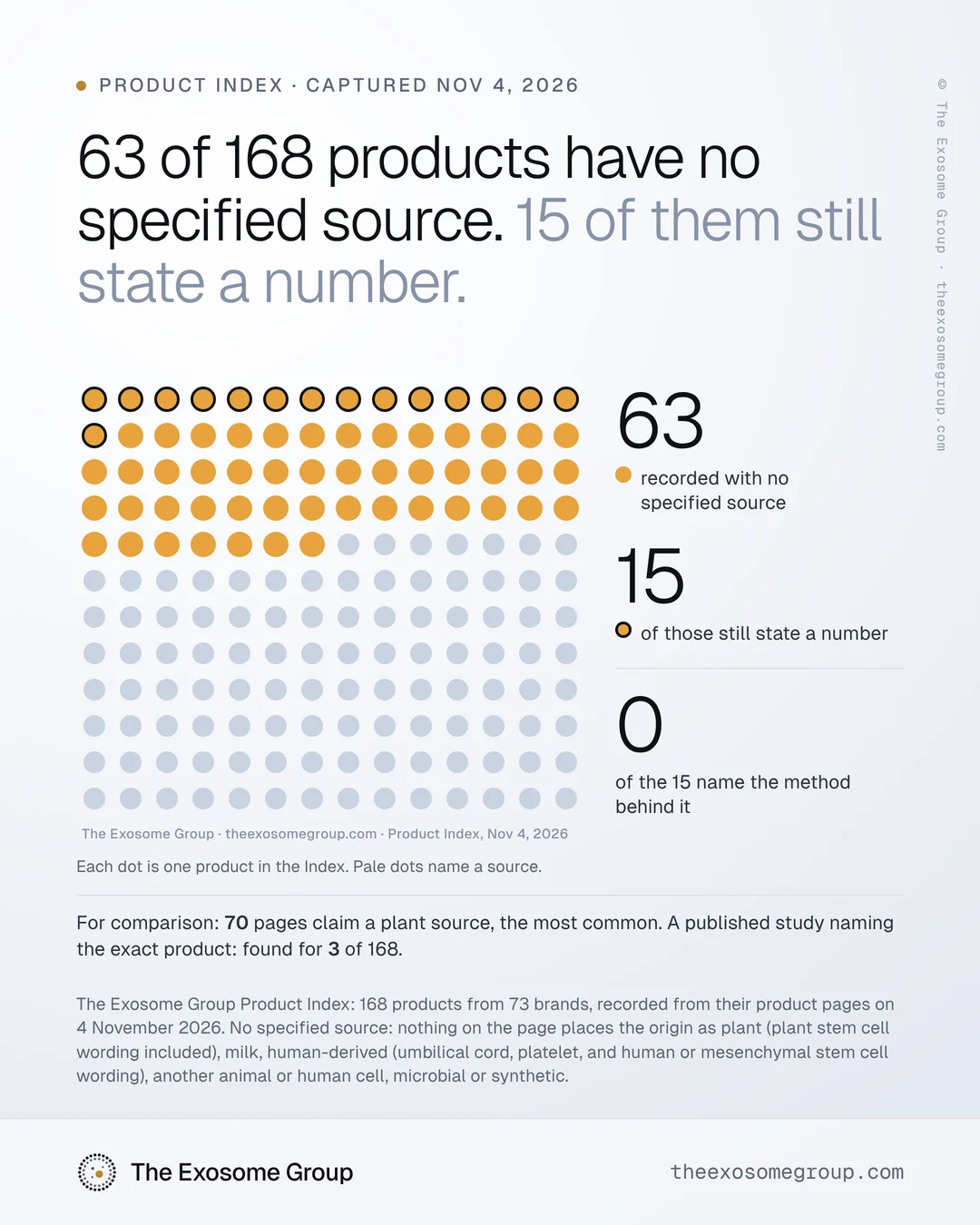
In our Product Index of 168 products from 73 brands, recorded from their product pages on 4 November 2026, 63 are recorded with no specified source for the vesicle material, which makes them the second-largest group after plant, at 70. Without a source, it cannot be decided which markers, separation steps and market rules apply. Of the 63, 15 still give a number with their exosome claim, 10 of them percentages of an ingredient or complex and 5 of them particle counts, and none of them names the method behind it.
Where do the vesicles in exosome products come from?
The most common claimed source is a plant, and the next largest group of pages names no origin that we can place. We recorded the vesicle source each page claims, counting each product once by the first source its page names:
| Vesicle source claimed | Products |
|---|---|
| Plant | 70 |
| No specified source | 63 |
| Human-derived or stem cell | 15 |
| Synthetic or biomimetic | 10 |
| Microbial or microalgae | 7 |
| Milk or colostrum | 2 |
| Animal or human cell, species not stated | 1 |
What counts as no specified source?
Under our coding rule, a page gets a source only when it names an origin that we can place in one of the classes above. Following the Index’s own coding notes, umbilical cord, platelet, and human or mesenchymal stem cell wording is counted as human-derived even when the page does not state a species. Plant stem cell wording, which six plant pages use, is counted as plant. A named cell type with no species, such as fibroblasts, is counted as an animal or human cell. A page that says “plant” without naming the plant is still counted under plant, since it states a kind of source. Of the 70 plant pages, 17 name no plant on the page, and 3 more do not name it in the passage we recorded.
Everything else is recorded with no specified source. One of the 63 comes close, because it names an extract but not the organism it came from, so it cannot be placed. Under a looser rule that counted any named extract, the figure would be 62 and the pattern would be the same.
What pages without a source say instead
These pages still use the word, and reading the 63 together, we found four patterns:
- Some name a branded technology or a named complex in place of a material, and 13 of the 63 carry a registered or trademark symbol in the wording we recorded.
- Some use the word “exosomes” on its own, with no origin attached.
- One page names an extract without the organism behind it.
- At least 7 of the 63 use exosome wording without stating that the product contains vesicles at all.
The last group needs a word of explanation. Our Index records pages that use exosome or extracellular vesicle wording as we found them, whether or not they claim that the product contains vesicles, although delivery-vesicle wording such as liposomes was left out. Those pages are part of how the word spreads, so they stay in the record, and they are counted here because they name no source.
The source determines which checks apply
The source of the material determines the appropriate method before any measurement is read. MISEV2023, the reporting guideline from the International Society for Extracellular Vesicles, organizes its advice on samples by source, with separate sections for cell culture media, bacteria, blood, urine, cerebrospinal fluid, saliva, synovial fluid, milk and solid tissue. The material that comes along with the vesicles differs from one source to the next, and so do the purity checks that are informative.
| Claimed source | Questions the source raises first |
|---|---|
| Plant | Markers built for plants rather than CD9, CD63 or CD81, and whether the material was released by cells or broken out of tissue |
| Milk or colostrum | How casein micelles and milk fat were removed |
| Human-derived or stem cell | Which cells, which species, and how markets that restrict material of human origin treat it |
| Microbial | MISEV2023 has a separate section for bacterial vesicles, with its own markers and controls |
| Synthetic or biomimetic | Whether the particles are native vesicles at all; MISEV2023 suggests names such as EV mimetics and discourages “exosome-like” |
| No specified source | None of these can be chosen until the source is known |
The plant question is covered in Animal-cell markers are the wrong first test for plant exosomes and Plant EVs and plant-derived nanovesicles are made by different routes. The milk question is covered in Casein micelles complicate exosome counts from milk, and the market question in Korea’s exosome wording guidance is based on the material’s origin.
Do pages without a source still state numbers?
Of the 39 pages in the Index that state a number for vesicle quantity, 15 name no source. Most of those numbers are percentages, and 8 of the 10 percentages come from a single product line, so the count says more about one line’s labels than about the group as a whole.
| Claimed source | Products | State a number | State a particle count |
|---|---|---|---|
| No specified source | 63 | 15 | 5 |
| Plant | 70 | 8 | 5 |
| Human-derived or stem cell | 15 | 7 | 6 |
| Synthetic or biomimetic | 10 | 4 | 1 |
| Microbial or microalgae | 7 | 3 | 3 |
| Milk or colostrum | 2 | 1 | 1 |
| Animal or human cell, species not stated | 1 | 1 | 1 |
| All products | 168 | 39 | 22 |
Of the 15, 10 are percentages and 5 read as particle counts, and none of the 15, like none of the 39 pages that state a number, names the method behind it. A count with no source and no method describes an unnamed material measured by an unnamed method, and it cannot be put to any source-specific question, because there is no source to start from.
Is there published evidence behind these products?
We found very little published evidence that names a product. We searched the literature for studies of the products in the Index and, for 3 of the 168 pages, found a published study that names the exact product. One of the three is among the 63 products with no specified source.
A published study naming a product is not the same as a measurement of its vesicles, and a study missing from our search does not mean that none exists, only that the public record we could find is thin.
This finding concerns pages
A supplier file or a certificate of analysis may name the source in full. What the page gives a buyer, a retailer or a customer, however, is the word without its origin, and that is what gets repeated in listings and reviews.
Limits of this finding
- The finding does not show what any product is made from, because the Index records page wording and we measured no product.
- The source determines which questions apply, but it does not rank one material above another.
- We do not assess whether any product works.
What to request from a supplier
- The source by organism, species and tissue or cell type, and the document that states it
- How the material was obtained: released by cells, recovered by breaking tissue, or made another way
- Which source-specific checks were run, such as plant-appropriate markers for a plant source or casein removal for milk
- Any number on the label, with its method, unit, lot and date
Each row in the Index records what a page says and carries no assessment of the product.
If you would like to see a category broken down further, you can email us at hello@theexosomegroup.com with what you would want to see.
Last reviewed . This note gives general scientific information about measurement and is not legal or regulatory advice or an assessment of any product.
Sources
- The Exosome Group Product Index: 168 products from 73 brands, recorded from their product pages on 4 November 2026. Each product’s page uses exosome or extracellular vesicle wording. Published as distributions only; no brand, product or page is named.
- Welsh JA et al. Minimal information for studies of extracellular vesicles (MISEV2023). J Extracell Vesicles. 2024;13(2):e12404.